
Why Some Girls Never Return After the Holidays
Every year, girls go home for the school holidays. Some of them don't come back. This article explores why, and what it means for the carbon credits our projects generate.

During a recent visit to schools in Zambia, we noticed that school dropout often spiked immediately after school holidays. Girls who had been enrolled, attending, and progressing simply never returned to class. As we spoke with teachers, families, and communities, two factors emerged repeatedly. Again and again, the stories pointed to two closely linked realities: pregnancy and child marriage.
Understanding these outcomes requires understanding some of the social pressures girls face when they return home.
When girls cannot stay in school
Pregnancy remains one of the leading causes of girls dropping out of school in Zambia, and the holidays are a high-risk period. In Zambia's Eastern and Northern Provinces, female initiation ceremonies known as Chinamwali or Chisungu mark the transition from girlhood to womanhood. These ceremonies carry deep cultural significance, but specific practices within them can put girls at risk: weeks of seclusion, with a heavy emphasis on preparing girls for a future husband. The social consequences for not participating are severe, girls who do not go through initiation, risk being ostracised and not being recognised as adults by their community, regardless of their age. For many girls, the pressure to participate is not a choice. This dynamic is not incidental. It is built into the structure of the ceremonies themselves:
“The teachings provided during initiation rites are intended to perpetuate a dominant position for men and a subordinate position for women, both in marriage and in the community.” (Kapungwe, 2003, cited in UNFPA, 2020)
That framing shapes the expectations girls return home to, and the decisions that get made for them. For many families, pregnancy and marriage are not separate problems but a single pathway: a girl becomes pregnant, and marriage follows as the expected next step. When families also face economic pressure and cannot afford to keep a girl in school, marriage becomes the default outcome even without pregnancy. Education ends not because a girl chose to leave, but because her circumstances left no other option.
Early pregnancies carry elevated risks of miscarriage, fistula, and maternal mortality and lead directly to dropout. Once a girl becomes pregnant, the dominant community message is that marriage takes precedence over school. Returning to education after an unplanned pregnancy is not just logistically difficult; it is often socially stigmatised in ways that make it nearly impossible for many girls. Rural communities account for 80% of all teenage pregnancies reported annually in Zambia. These are the communities where Katla Carbon works.
From the Field
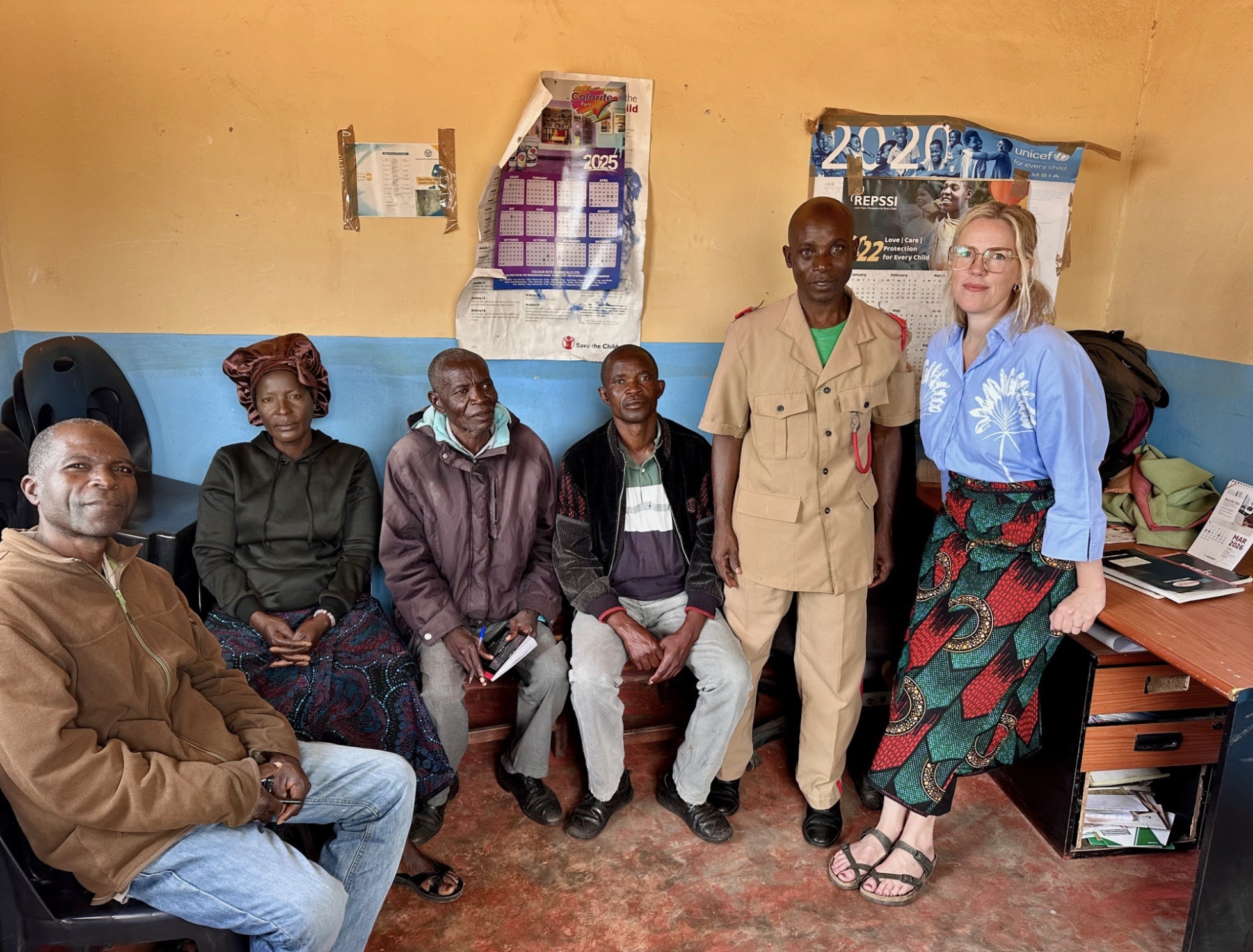
Founder, Guðný Nielsen meets with a village committee in Katete District
During a monitoring visit to Katete District in Eastern Province, I had the chance to speak with Chieftainess Kawaza, the traditional leader of a chiefdom spanning some 650 villages across one of Zambia's highest-risk districts for child marriage. She spoke with a directness that left little room for abstraction: child marriage was a problem her community was adamant about solving.
Earlier that day, I had visited one of the village committees working under her leadership. What struck me was how seriously they took their responsibility. Committee members knew the girls in their community, followed up when someone had not returned to school, if a girl had been married, they would retrieve her from marriage and together with her family address the barriers standing in her way.
Chieftainess Kawaza has built that accountability into multiple villages across her chiefdom: committees tasked with identifying cases of child marriage before they became irreversible, community dialogues to shift the norms driving them, and partnerships with local schools that helped reintegrate over 270 girls back into the classroom in 2023 alone.
Sitting with that committee, and hearing Chieftainess Kawaza speak, left me genuinely hopeful. There are people across these communities, traditional leaders, headmen, teachers, parents, all working toward the same goal, and they are not waiting for permission to act. (Observation by Guðný Nielsen, Katete District, Eastern Province, 2026)
The story Chieftainess Kawaza described is not unique to her chiefdom. Across the districts where Katla Carbon works, the same pressures repeat: holidays that become turning points, pregnancies that close doors, marriages that are framed as solutions. Katla Carbon's role is to make intervention possible at scale, and to ensure that girls receive the practical support needed to stay in school. The carbon credits are not simply financing classroom hours. They are financing the full set of conditions that make attendance possible, such as boarding, school uniforms, textbooks, lunch, and menstrual hygiene products. A girl who cannot manage her period at school does not stay at school.
A pathway back
Katla Carbon does not operate in a vacuum. The policy context that shapes whether girls can return to school is shifting too. In March 2026, Zambia's Ministry of Education, with support from UNESCO, launched revised School Re-Entry Policy Guidelines, providing practical direction for supporting girls who have left school due to pregnancy to return and complete their education. The revised guidelines build on Zambia's original 1997 policy framework and treat pregnancy not as the end of a girl's education, but as an interruption the system has a responsibility to address.
At the launch, young women shared testimonies about their journeys after being given the opportunity to re-enter school, calling on government stakeholders to protect every girl's right to education. Their presence was a reminder that the question is not only whether girls can be kept in school, but whether those who fall through the gaps can find their way back.
Keeping girls enrolled reduces the risk of early pregnancy. The re-entry policy creates a pathway for those it does not. Together, they represent something that field data alone rarely delivers: a reason for genuine optimism.